
ASMR Cleaning: Home Makeover
Amazuro StudioPuzzle
3.12.00 Reviews
- Version
- 3.34
- Installs
- 1.00M
- Age Rating
- Everyone
Screenshots

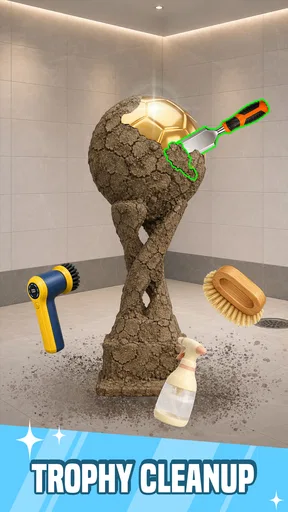



Our Review of ASMR Cleaning: Home Makeover
 Analysis by Appyee
I went into ASMR Cleaning: Home Makeover expecting a simple puzzle game built around tidying rooms, and that is exactly the kind of experience it offers. The appeal is not a complicated story or a demanding strategy system. It comes from taking a visibly messy space, choosing the next cleaning action, watching the disorder disappear, and feeling that small sense of completion when the room looks transformed. That straightforward loop makes it easy to understand within moments.
As a free game from Amazuro Studio, it sits in the casual puzzle corner rather than trying to compete with large, feature-heavy makeover simulations. The age rating of Everyone also matches its approachable presentation. I could imagine handing it to someone who wants a quiet distraction, a short break between tasks, or a game that does not require learning a long list of rules before becoming enjoyable.
There is an important distinction, though. This is a game about the feeling of cleaning, not a household organizer or a practical guide to making a real home more efficient. Its value is the satisfying sequence of actions and visual improvement. If that sounds appealing, the game has a clear purpose. If you want deep puzzle planning, realistic renovation tools, or a detailed decorating sandbox, you may find the experience too narrow.
How the cleaning loop feels from the first action
The first thing that works in the game is how quickly the objective becomes readable. A messy room gives you an obvious starting point: identify something that needs attention and interact with it. There is no need to understand a complex economy, memorize character abilities, or study a map. The visual state of the room tells you what kind of progress you are meant to make.
That makes the opening action feel more like a gentle invitation than a test. I can begin by clearing an untidy area, dealing with an item that is out of place, or following the visual sequence presented by the room. The pleasure comes from seeing a small problem disappear immediately. One action creates a visible improvement, which naturally points toward the next action.
This is where the puzzle design is more tactile than cerebral. The challenge is generally about noticing what belongs to the current task and carrying out the appropriate interaction. Players who enjoy hidden-object games may recognize that rhythm, but the emphasis here is not on searching for a single cleverly concealed answer. It is on gradually reducing the room's visual noise.
I found that distinction useful when deciding how to approach a session. Trying to rush through every object can make the game feel mechanical. Instead, I enjoyed treating each area as a small sequence: look, choose, clean, observe the result, then reassess. That pause after each action matters because the room itself becomes the progress indicator.
The strongest part of the design is that every small action has a visible consequence. A game about tidying would lose much of its appeal if the screen barely changed after an interaction. Here, the basic promise is easy to understand: work through the mess and watch the space become more orderly. That clarity is likely one reason the game has reached over a million installs, even though its average rating is a more modest 3.1 from around 150 ratings.
The feedback rhythm keeps simple actions interesting
Once I started cleaning, the game’s main rhythm became clear. I perform an action, receive immediate visual feedback, and then look for the next unfinished part of the room. That cycle is uncomplicated, but it is also the reason another session can begin after I have just finished one. The game turns progress into a series of tiny confirmations rather than one distant goal.
In many puzzle games, feedback means points, timers, or a loud success message. The more effective feedback here is visual transformation. A surface that looked neglected becomes cleaner. An item that disrupted the room no longer does so. The screen gradually shifts from cluttered to controlled. Even when the underlying interaction is simple, that change gives the player a reason to continue.
I would describe the pace as best suited to players who like low-pressure repetition. There is satisfaction in doing something obvious and seeing the result immediately. It can be a good fit after a tiring day when I want a game that asks for attention without demanding intense concentration. It also works for short visits because the basic interaction does not require a long explanation.
That same simplicity is the main limitation. Players who need every move to involve a meaningful deduction may feel that the puzzle layer is light. The game’s tension does not come from difficult logic or a harsh penalty for choosing incorrectly. It comes from the desire to finish the visual cleanup. If you usually choose puzzle games for intricate solutions rather than calming repetition, this may feel closer to a relaxing activity than a traditional brainteaser.
A useful way to play is to focus on one visible cluster at a time instead of scanning the entire room repeatedly. I found that this reduced the feeling of searching and made the progress easier to notice. It also creates natural mini-goals: finish one corner, then move to the next. That approach is more satisfying than treating the room as an undifferentiated pile of tasks.
Why the reward is visual rather than competitive
The reward in ASMR Cleaning: Home Makeover is the completed environment. The game does not need a complicated narrative justification for the player to care about progress. The room begins in an unsatisfying state, and the reward is seeing it become presentable. That can be surprisingly effective because the result is understandable at a glance.
I especially like this kind of reward when I do not want to compare my performance with anyone else. There is no need to chase a personal record or prove that I solved a puzzle faster than another player. The motivation is internal: I started with disorder, I made a series of choices, and now the space looks better. That makes the game more welcoming than competitive puzzle titles for some players.
The makeover framing also gives the cleaning actions a sense of direction. I am not simply tapping objects until the screen changes. I am working toward a recognizable before-and-after result. Even if the individual steps are small, the combined effect makes the session feel complete when the room reaches its finished appearance.
For parents looking for something suitable for a broad age range, the Everyone rating makes the game easy to consider from a content perspective. I would still judge the experience by the player’s taste rather than the rating alone. A younger player may enjoy the clear visual goals, while an adult may prefer it as a calming break. Neither group should expect a detailed home-design tool; the focus is the cleaning process and its immediate payoff.
One practical tip is to treat the completed room as a stopping point rather than assuming every session must become a long play period. The game’s reward is strongest when the transformation still feels fresh. Playing for a few minutes, finishing a cleaning sequence, and leaving with a visible result can be more enjoyable than continuing after the basic satisfaction has already passed.
When the session resets and why I return
The reset is central to this type of game. Once a room has been cleaned and its visual problem is resolved, the reason to play again is not that the previous result was meaningless. It is that the game offers another space or another mess to work through. The loop starts over with a new visual problem, and the familiar actions become a comfortable routine.
That structure makes the game easy to revisit during everyday gaps. I could see using it while waiting for an appointment, taking a short break from work, or winding down before bed. The session does not need the commitment that a long story game demands. I can open it, complete a small sequence, and stop once the room feels finished.
A realistic example would be coming home after dealing with a cluttered day and wanting a version of tidying that has no real-world consequences. In my actual home, cleaning may involve deciding what to keep, finding storage, and dealing with tasks that take much longer than expected. In this game, the visual mess is contained and the result arrives quickly. That contrast is the point: it offers the emotional reward of order without asking me to reorganize my own cupboards.
There is a trade-off in that reset structure. Players who enjoy unlocking a large collection of tools, customizing every detail, or building a home over many hours may want a more substantial simulation. A dedicated decorating game would usually be the better choice for furniture placement and personal design. A traditional logic puzzle would be better for players who want increasingly complex reasoning. This game is more focused: clean the space, enjoy the change, and begin again when another short task sounds appealing.
Because the game is free, it is also easy to try without treating the first session as a major commitment. The current version is 3.34, and it runs on devices using Android 7.1 or later. Those details make it accessible to people who are not using the newest phone, although the experience will still depend on the individual device and how comfortably the controls respond on its screen.
Who will enjoy it, and who should skip it
I would recommend this game to players who enjoy visual order, gentle puzzle interactions, and short sessions with a clear ending. It suits people who like watching a messy situation become neat one step at a time. It is also a reasonable choice for anyone who finds ASMR-style cleaning content relaxing but would rather participate in the transformation than simply watch it.
It may be particularly appealing if you prefer games that explain themselves through presentation. The room communicates the objective, and the improvement communicates the reward. That makes it less intimidating than games that begin with several menus, currencies, or systems. The trade-off is that there is less room for mastery once the basic pattern becomes familiar.
I would skip it if your main reason for playing puzzle games is to wrestle with difficult logic. I would also look elsewhere if you want realistic cleaning techniques, a serious home-management system, or a deep renovation simulator. The title suggests a makeover, but the heart of the experience is the satisfying cleanup loop rather than a professional design workflow.
Another point worth considering is the rating. An average of 3.1 means the game’s simple appeal will not work equally well for everyone. With only a small number of written reviews compared with its install reach, I would not use that score alone to predict your experience. Instead, ask yourself whether the action-feedback-reward pattern sounds enjoyable. If repeated visual tidying feels relaxing to you, the rating may matter less than the fit with your personal taste.
How it compares with other puzzle and cleaning alternatives
Compared with match-style puzzle games, this title is less about arranging symbols under pressure and more about interacting with a recognizable environment. The satisfaction comes from the room changing, not from building a long chain or planning a board several moves ahead. That makes it calmer, but also less strategically demanding.
Compared with hidden-object games, the search is more connected to a practical goal. I am not simply locating items for a list; I am trying to make the whole space feel orderly. Players who like a strong before-and-after payoff may prefer this approach. Players who enjoy obscure clues and carefully concealed objects may find the cleaning tasks too direct.
Compared with home-design games, the focus is narrower and more immediate. A design simulator usually asks me to make aesthetic choices, compare furniture, or shape a room according to a personal style. Here, the first priority is removing the mess. That gives the game a cleaner sense of purpose, but it leaves less space for creative self-expression.
Its closest advantage over those alternatives is the low barrier to entry. I do not need to remember a story, maintain a complicated upgrade plan, or prepare for a difficult level. Its closest disadvantage is the same simplicity: once the visual routine stops feeling rewarding, there may not be enough strategic depth to pull me back.
Small habits that make each session better
I got more from the game when I used a deliberate sequence instead of tapping randomly. First, I scanned the room for the most visually disruptive area. Next, I completed the nearby actions before jumping elsewhere. Finally, I paused to see what the cleanup had revealed. This method made the transformation easier to appreciate and reduced unnecessary movement across the screen.
Another useful habit is to play with a specific mood in mind. For a quick break, I focused on completing one visible section. For a longer session, I let the room’s gradual transformation provide the momentum. That distinction prevents the game from feeling like an obligation. It is better treated as a small relaxation tool than as a checklist that must be exhausted.
I also recommend judging the experience by how the feedback feels rather than by how complex the controls are. The game’s strength is not hidden depth in every interaction. It is the consistency between action and result. If that connection gives you a pleasant sense of progress, the simplicity becomes a feature. If you need surprise and difficulty at every step, no amount of visual polish in the cleaning loop will fully solve that mismatch.
My verdict on the repeatable makeover loop
ASMR Cleaning: Home Makeover succeeds when I want a compact, visually clear puzzle experience built around restoring order. Its first action is easy to understand, its feedback arrives through visible change, and its reward is the satisfying completion of a room. The reset works because another messy space offers another chance to repeat that transformation.
It is not the right game for deep strategy, serious interior design, or realistic household advice. The cleaning actions are valuable as interactive relaxation, not as a substitute for a full simulation. Some players will also find the loop repetitive once the initial novelty fades. That limitation should be part of the decision, especially for anyone who normally expects puzzle games to keep introducing more demanding mechanics.
Still, I think the game knows what it wants to be. It is a free, Everyone-rated casual puzzle from Amazuro Studio that turns a familiar chore into a sequence of quick visual rewards. I would recommend trying it if you like calming cleanup videos, simple room transformations, or games that can be enjoyed in short visits. I would pass on it only if the lack of demanding logic or detailed decorating would bother me more than the satisfaction of watching a messy home become orderly.
Verdict
Strengths of ASMR Cleaning: Home Makeover
- Relaxing ASMR sounds make routine cleaning tasks feel satisfying.
- Simple controls are easy to learn for players of all ages.
- Home makeover progress gives each level a clear sense of reward.
- Short stages work well for quick gaming sessions.
- Colorful visuals make the rooms pleasant and engaging to restore.
Limitations of ASMR Cleaning: Home Makeover
- Gameplay can become repetitive after completing several similar cleaning tasks.
- Some upgrades or tools may require watching ads or spending resources.
- The relaxing pace may feel too slow for players seeking action.
- Limited challenge could reduce long-term appeal for experienced gamers.
- Progress may depend on repeated levels to unlock more makeover options.
Similar Picks in This Category
View All
Block Blast!
HungryStudio4.8

Braindom: Brain Games Test
Lahana Game Studio4.6

AMAZE!
CrazyLabs LTD4.6

Sudoku - Classic Sudoku Puzzle
Oakever Games4.7

Art Puzzle - Puzzle Games
Easybrain4.8

Amaze GO!
Oakever Games4.9
Frequently Asked Questions
What is ASMR Cleaning: Home Makeover?
ASMR Cleaning: Home Makeover is a relaxing simulation game focused on tidying, cleaning, repairing, and decorating different rooms. You complete satisfying household tasks such as removing dirt, organizing objects, fixing damaged areas, and refreshing furniture. The game combines simple tap-and-swipe controls with visual cleaning effects, making it suitable for players who enjoy casual gameplay, makeover challenges, and calming ASMR-style interactions.
How do you play ASMR Cleaning: Home Makeover?
Gameplay is designed to be easy to understand, even for people who do not regularly play mobile games. You usually select a room or makeover project, follow the highlighted objectives, and use the available tools to clean or repair each area. Completing tasks unlocks additional stages, decorations, or improvements. Most actions rely on tapping, dragging, or swiping, so no complicated controls are required.
Is ASMR Cleaning: Home Makeover free to download and play?
The game is generally available as a free download, allowing you to try its main cleaning and decorating mechanics without paying upfront. However, free mobile games may include advertisements, optional purchases, or items that can be unlocked more quickly through payment. Before downloading, it is worth checking the current store listing for details about in-app purchases, advertising, and any restrictions on offline access.
Does ASMR Cleaning: Home Makeover require an internet connection?
Some parts of ASMR Cleaning: Home Makeover may work without a constant internet connection, particularly the basic cleaning and makeover levels. Nevertheless, an internet connection can be necessary for advertisements, downloadable content, updates, cloud-related features, or restoring purchases. Availability may also differ between Android and iOS versions, so you should test the game offline after installation if offline play is important to you.
Is ASMR Cleaning: Home Makeover suitable for children?
The game uses straightforward, non-violent cleaning and decorating activities, which can make it appealing to children and families. Even so, parents should review the age rating, advertising, and in-app purchase information before allowing younger players to use it. Some tasks may also encourage repeated play, while advertisements or optional purchases could appear, so parental controls and purchase restrictions are recommended.
Play our best games!


